Kaveri class 9 chapter 1 solutions pdf free download- here, we are going to provide you the Kaveri class 9 chapter 1 solutions. queryexpress gives you the best solutions to Class 9 English Kaveri Chapter 1 Summary, Questions & Answers (2026–27). go through it and download Kaveri Class 9 chapter 1 pdf. queryexpress provides the best solutions to class 9 New English book 2026-27.
Kaveri class 9 chapter 1 solutions pdf free download
Get easy summary, important questions, themes, and notes for Class 9 English Kaveri Chapter 1 How I Taught My Grandmother to Read (2026–27 updated syllabus).
Class 9 English Kaveri Chapter 1 Summary, Questions & Answers (2026–27)
Important Themes of the Chapter 1 kaveri
🔹 Value of Education
Education helps a person become independent and confident.
🔹 No Age Limit for Learning
The grandmother proves that anyone can learn at any age.
🔹 Determination and Hard Work
Strong willpower helps overcome all difficulties.
🔹 Respect for Knowledge
The grandmother respects her granddaughter as a teacher.
Kaveri class 9 chapter 1 Summary
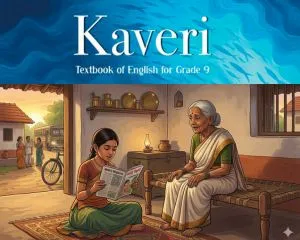
The grandmother loved listening to a story called Kashi Yatre. Her granddaughter used to read it to her every week. When the granddaughter went away, the grandmother could not read the story herself. She felt sad and dependent. This made her decide to learn reading. She worked very hard and learned the Kannada alphabet. On Dussehra, she read a book on her own and felt proud. She touched her granddaughter’s feet as a mark of respect. The story shows that learning has no age limit.
Character Sketch of Grandmother
🔹 Determined and Strong– She decides to learn despite her age.
🔹 Humble Learner-She is not ashamed to become a student.
🔹 Independent Thinker-She wants to read on her own without help.
Message of the Story
🔹 Learning is Lifelong-There is no age to gain knowledge.
🔹 Education Gives Freedom-Reading and writing make life easier.
🔹 Respect Knowledge-A teacher should always be respected.
Kaveri class 9 chapter 1 solutions
II. Critical Reflection
Extract 1 Analysis
When the narrator returned to the village, she found her grandmother in tears. This was shocking because the grandmother had never cried even in the toughest times. The narrator was worried and asked, “Avva, is everything alright?” (Avva means ‘mother’ in the Kannada spoken in north Karnataka.)
That night, under the full moon on the open terrace, the grandmother came and sat beside her granddaughter. She gently placed her affectionate hands on the narrator’s forehead.
Answers:
- The grandmother can be described as strong-willed.
- Grandmother did not reply immediately because she was too emotional to speak.
- Rural clue: They were sleeping on the open terrace of the house, and the narrator calls her “Avva”.
- The atmosphere feels tender and loving because of the line “Her affectionate hands touched my forehead.”
- The extract does not mainly focus on the grandmother’s regret over lack of education. It focuses more on the emotional moment when the narrator returns and notices her grandmother crying.
Solutions for Critical Reflection (Extract 2)
(i) What does the grandmother’s statement, “I want to be independent,” reveal about her character? Answer: It shows that she deeply desires self-sufficiency and does not want to depend on others.
(ii) The grandmother’s determination shows that learning has no age limit.
(iii) The narrator laughed at her grandmother’s decision to learn the alphabet at the age of sixty-two because she thought that a woman with grey hair, wrinkled hands, and heavy kitchen work was too old to start learning something as basic as the alphabet.
(iv) Two qualities displayed by the grandmother:
- Determination
- Humility
(v) The narrator is making assumptions about her grandmother because she judges her based on her physical appearance (grey hair and wrinkled hands) and domestic responsibilities. She wrongly assumes these things are barriers to learning, without realising her grandmother’s inner strength and mental capacity.
How I taught my grandmother to read questions answers
Exercise II (Short Answers – Page 32)
- Why did the grandmother feel embarrassed to ask someone else to read Kashi Yatre to her? She felt embarrassed because she was an elderly woman who was highly respected in the family. She didn’t want others to know that she couldn’t read. It made her feel weak and dependent, which she found humiliating.
- Why did the narrator initially laugh at her grandmother’s decision to learn at 62? The narrator had a childish way of thinking. She saw her grandmother as an old woman with grey hair and wrinkled hands who was always busy in the kitchen. She simply couldn’t imagine someone of that age starting to learn the alphabet from scratch.
- What is the significance of the story Kashi Yatre? Kashi Yatre was very close to the grandmother’s heart. She strongly related to its main character. When she couldn’t read it while the narrator was away, she felt helpless. This helplessness became the turning point that motivated her to learn to read.
- What does the grandmother’s desire to learn the Kannada alphabet reflect about her? It reflects her strong determination, courage, and desire for independence. It also shows her positive belief that learning has no age limit.
- What lesson do we learn from the grandmother touching the narrator’s feet? It teaches us that respect should be given to a person based on knowledge, not just age. The grandmother showed great humility by accepting her own granddaughter as her teacher. It reminds us that a true learner is always humble.
- What does the line “For a good cause if you are determined, you can overcome any obstacle” tell us? This line beautifully captures the central theme of the story — the power of determination. It tells us that no obstacle (not even old age) can stop us if we are truly determined to achieve something meaningful.
- How does the story highlight the value of education for personal independence? The story beautifully shows that education gives us freedom and confidence. Before learning to read, the grandmother felt helpless and dependent. After she learned, she felt proud and self-reliant. Education truly empowers people to live with dignity.
Short Answer Questions (Summary)
- The grandmother’s desire to be “independent” shows how much she values self-sufficiency and dignity.
- She is both determined and humble.
- The narrator laughed because of her childish assumption that 62 was too old to start learning the basics.
III. Vocabulary and Structures
Prefixes (Opposites)
- Belief → Disbelief
- Important → Unimportant
- Respect → Disrespect
- Correct → Incorrect
- Continue → Discontinue
- Understand → Misunderstand
- Ordinary → Extraordinary
- Possible → Impossible
Idioms
- To hit the books → To study seriously
- To draw a blank → To be unable to remember something
- To learn the ropes → To understand how to do a new activity
- To learn by heart → To memorise something
- Burn the midnight oil → To study or work late into the night
Grammar – Past Perfect & Simple Past (Page 36)
Fill in the blanks
A. When the delegates arrived at the conference, the keynote speaker had already begun the session.
B. After the students had learned how to identify fake news, they started verifying information.
C. Before Kiran started using digital payment platforms, she had ensured her understanding of online fraud prevention.
D. By the time Varun recognised the importance of budgeting, he had exhausted most of his savings.
E. When Raghu logged in to the webinar, the instructor had already discussed the importance of strong passwords.
Listen and Respond (Digital Literacy)
- Literacy these days includes the ability to use digital devices.
- Digital literacy is also about protecting personal information.
- Digital literacy enables the elderly to stay connected.
- It helps us use the internet safely by recognising online scams and fake news.
- The National Digital Literacy Mission helps people across the country by teaching essential digital skills.
Download: Class 9 English Kaveri Chapter 1 Notes PDF
Why did the grandmother feel helpless?
She could not read the story when her granddaughter was away. This made her feel dependent.
Why did she decide to learn?
She wanted to become independent and read on her own.
What change came in the grandmother after learning?
Before learning, the grandmother felt helpless and dependent. She could not read simple texts. After learning, she became confident and independent. She could read on her own and felt proud. This shows the power of education.